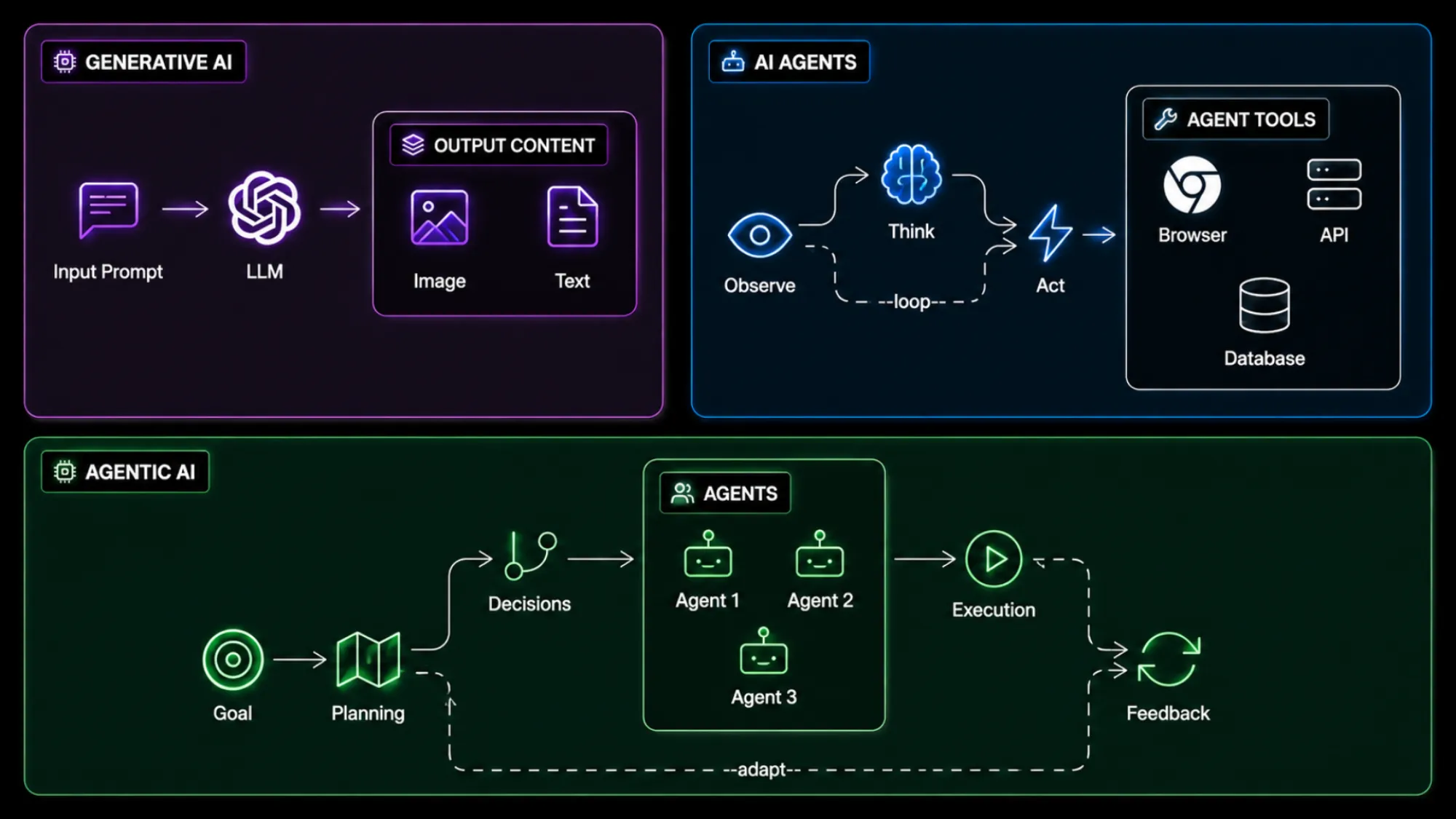
Artificial intelligence is evolving fast, and with it, new terms are entering the conversation that often confuse even technology smart users. Three of the most commonly misunderstood terms today are Agentic AI, AI Agents, and Generative AI. While they may sound similar, they represent very different levels of capability and purpose. Understanding the difference is important, especially for creators, developers, and businesses looking to adopt AI effectively.
At a basic level, Generative AI focuses on creating content, AI Agents focus on performing tasks, and Agentic AI goes a step further by making decisions and acting autonomously toward a goal. What this really means is that we are moving from passive AI tools to systems that can think, plan, and execute actions with minimal human input.
What is Generative AI?
Generative AI refers to systems designed to create content such as text, images, audio, or code based on user input. Tools like ChatGPT or DALL·E are examples of this category. These systems rely on large datasets and patterns to generate outputs that mimic human creativity. However, Generative AI has a limitation. It does not take independent action. It responds only when prompted and does not have memory-driven goals or decision-making capabilities. In simple terms, it is reactive rather than proactive. It is powerful for content generation but not designed for executing workflows or achieving long-term objectives.
What are AI Agents?
AI Agents are systems designed to perform specific tasks autonomously based on predefined instructions or goals. Unlike Generative AI, which only responds to prompts, AI Agents can take actions such as browsing the web, sending emails, managing workflows, or interacting with software tools. An AI Agent typically works in a loop of observing, thinking, and acting. It can use multiple tools and APIs to complete a task without continuous human input. For example, an AI Agent could be programmed to research a topic, summarize findings, and send a report automatically. However, most AI Agents still operate within a limited scope. They follow defined instructions and may not adapt well to complex or unpredictable environments. They are task-oriented but not fully independent decision-makers.
What is Agentic AI?
Agentic AI represents the next level of artificial intelligence. It combines the capabilities of Generative AI and AI Agents but adds autonomy, planning, and goal-driven behavior. Instead of just executing tasks, Agentic AI systems can define sub-tasks, make decisions, adjust strategies, and continuously work toward a larger objective.
This means Agentic AI behaves more like a digital worker than a tool. It can analyze a goal, break it into steps, choose the best approach, and execute actions across multiple systems. It also has the ability to learn from feedback and improve over time.
For example, an Agentic AI system could be given a goal like growing a business. It could plan marketing strategies, create content, analyze performance, optimize campaigns, and iterate without constant human direction. This level of autonomy is what separates Agentic AI from traditional AI systems.
Key Differences Between Agentic AI, AI Agents, and Generative AI
The core difference lies in autonomy and purpose. Generative AI is focused on creation, AI Agents are focused on execution, and Agentic AI is focused on decision-making and goal achievement. Generative AI waits for instructions, AI Agents follow instructions, and Agentic AI can create its own plan of action.
Another major difference is adaptability. Generative AI does not adapt beyond its prompt, and AI Agents have limited flexibility based on predefined logic. Agentic AI, on the other hand, can dynamically adjust its approach based on results and changing conditions.
From a business perspective, Generative AI helps with productivity, AI Agents help with automation, and Agentic AI enables full-scale intelligent systems that can replace or augment human roles in complex workflows.
Why This Difference Matters in 2026?
Understanding these differences is not just theoretical. It directly impacts how businesses and individuals use AI. Many people think they are using advanced AI when they are only using Generative AI tools. The real shift is happening toward Agentic AI, where systems are no longer just assistants but active participants in achieving outcomes. Companies are already experimenting with multi-agent systems and autonomous workflows, which are early forms of Agentic AI. This transition will redefine how work is done, especially in areas like marketing, customer support, operations, and software development.
Agentic AI, AI Agents, and Generative AI are not competing concepts but different stages in the evolution of artificial intelligence. Generative AI creates, AI Agents execute, and Agentic AI decides and acts with purpose. As technology advances, these systems will increasingly merge, but understanding their differences today gives you a clear advantage in using them effectively.